
Night Guard for Teeth Grinding in Pune
What Is Bruxism?
Bruxism is the involuntary grinding, clenching, or gnashing of teeth, most commonly during sleep, when the patient is entirely unaware it is happening. The forces generated during grinding significantly exceed those of normal chewing, and they are sustained over hours rather than seconds. The cumulative effect on teeth, restorations, and the jaw joint is substantial.
Enamel, the hardest substance in the human body, wears down under sustained grinding force. Teeth shorten. Their biting surfaces flatten. Cusps chip and fracture. Existing restorations – fillings, crowns, veneers – are placed under stress they were not designed to sustain and fail prematurely. The muscles involved in grinding become chronically overworked, leading to morning jaw pain, facial tenderness, and headaches. Left unaddressed for long enough, severe bruxism contributes to temporomandibular joint dysfunction, jaw pain, clicking, and restricted opening that requires dedicated treatment to manage.
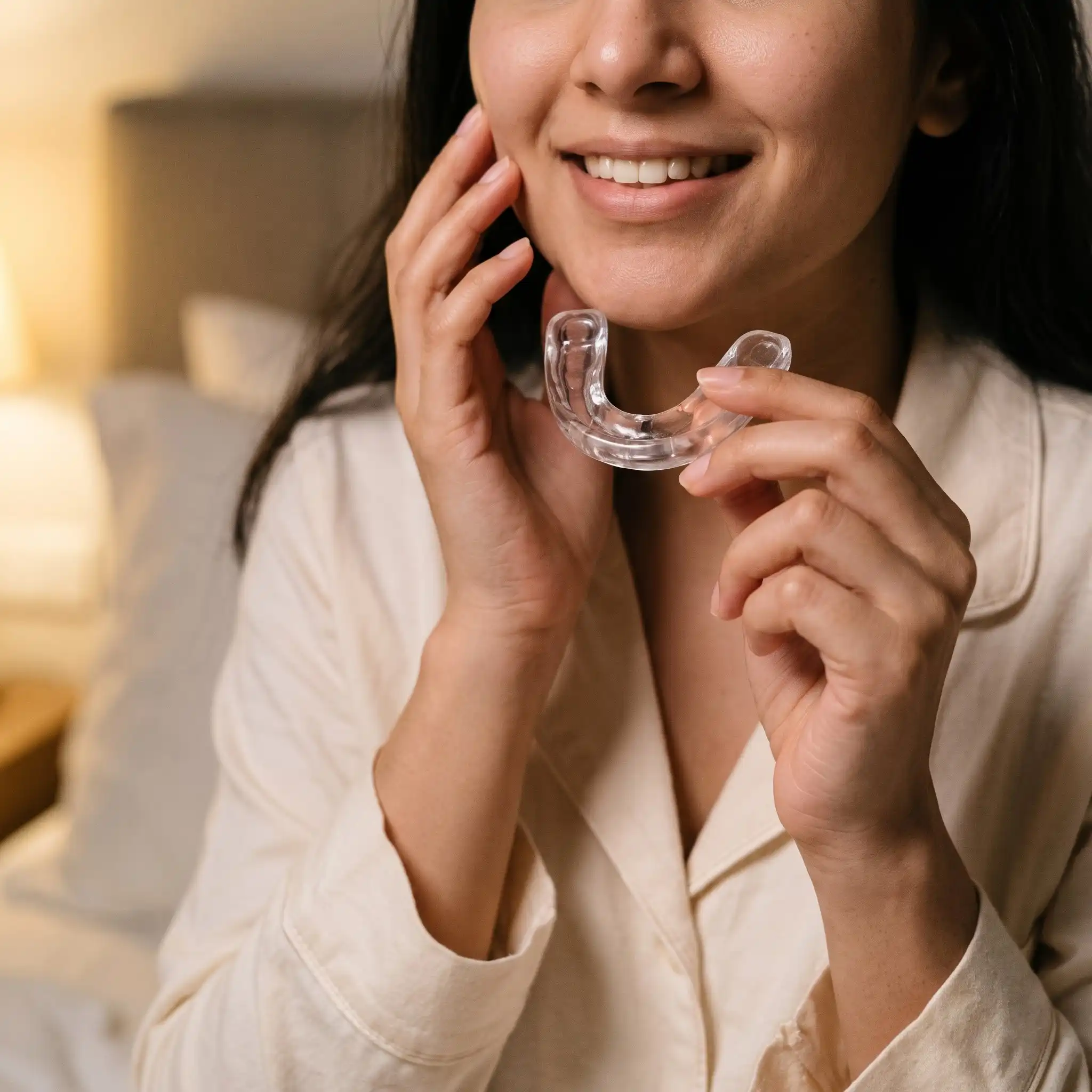
A night guard does not stop the grinding; it cannot. What it does is intercept the forces it generates, protecting the teeth and restorations from the wear and fracture that direct tooth-on-tooth contact causes, and reducing the load transmitted to the jaw joint and its surrounding musculature.
Who Should Consider a Night Guard?
Signs That Bruxism Is Already at Work.
Bruxism is often identified by a dentist before the patient is aware of it, through the wear patterns visible on the teeth at a routine check-up. You may benefit from a night guard if:
- Your dentist has identified wear facets, flattened or worn areas on the biting surfaces of your teeth
- You wake with jaw pain, facial soreness, or a headache around the temples
- Your teeth feel sensitive to cold in the morning; wear that exposes dentine causes temperature sensitivity
- A partner has reported the sound of grinding during the night
- You clench your teeth during the day, particularly under stress
- You have existing crowns, veneers, or other restorations that need protection from excessive force
- You are experiencing early TMJ symptoms, clicking, discomfort when opening wide, or jaw fatigue
Identifying bruxism early, before significant wear has accumulated, allows a night guard to protect what remains. The wear that has already occurred cannot be reversed without restorative treatment. A night guard prevents further loss.
Your Night Guard at Halo 32
Assessment
Your teeth are assessed for wear, the degree of bruxism activity is evaluated, and your bite is analysed. Where TMJ symptoms are present alongside grinding, these are noted and addressed as part of the broader management plan, a night guard alone may not be sufficient, and additional treatment such as laser TMJ therapy may be discussed.
Digital Scan
A 3D intraoral scan captures the precise dimensions of your teeth and bite relationship. This data is used to fabricate a guard that fits your specific dental anatomy exactly, not adapted from a standard template.
Fabrication
Your night guard is fabricated in a dental laboratory from high-quality, hard acrylic or dual-laminate material depending on the severity of the bruxism and the clinical recommendation. The guard is made to the precise dimensions of your bite, flat on the opposing surface to allow the jaw to move freely during sleep without locking into a position that increases muscle tension.
Fitting & Occlusal Adjustment
The guard is fitted, and the bite is carefully adjusted, ensuring even contact across the guard surface and no premature contacts that would create additional muscle tension. This occlusal adjustment is a critical step that distinguishes a clinically made night guard from an over-the-counter alternative. You leave with a guard that is comfortable to wear and correctly balanced for your bite.
What a Night Guard Does for You
Prevents Further Tooth Wear
A night guard places a barrier between the upper and lower teeth during sleep, the hours when grinding force is applied most consistently and at its greatest magnitude. The guard absorbs and distributes this force, protecting the enamel and dentin surfaces from the direct contact that causes wear.
Protects Existing Restorations
Crowns, veneers, composite fillings, and implant-supported restorations are all vulnerable to the forces of sustained grinding. A night guard significantly extends the lifespan of existing restorations by reducing the load they are exposed to during sleep.
Reduces Jaw Muscle Tension
A correctly balanced night guard, one in which the bite surface is flat and evenly distributed, allows the jaw muscles to relax during sleep rather than sustaining the contraction of grinding. Patients typically notice a reduction in morning jaw pain and headaches within the first weeks of consistent wear.
Slows the Progression Toward TMJ Dysfunction
Unmanaged bruxism is a significant contributing factor to temporomandibular joint dysfunction. A night guard reduces the load on the joint during the hours of highest grinding activity, slowing the progression of joint-related symptoms and reducing the likelihood of requiring more involved intervention later.
What to Expect After Your Filling
An Adjustment Period. Then, a Noticeably Better Morning.
Most patients adapt to wearing a night guard within one to two weeks. The first few nights may feel unusual; this is normal and resolves as the habit becomes established.
- Adjustment Period: One to two weeks for most patients. Mild awareness of the guard during sleep is normal initially.
- Morning Symptoms: Most patients notice a reduction in jaw pain and morning headaches within the first few weeks of consistent wear.
Care: Rinse the guard each morning. Clean with a soft brush and mild soap. Store in the ventilated case provided. Bring to check-up appointments for assessment.
Wear: Night guards should be assessed every six to twelve months. Significant bruxers may wear through a guard over two to three years, replacement is recommended when wear is visible.
Why Halo 32 for Your Night Guard

Clinically Assessed, Not Just Prescribed
At Halo 32, a night guard recommendation follows a thorough assessment of the degree of wear, the bite relationship, and the presence of any TMJ symptoms. Where bruxism is part of a broader picture of jaw dysfunction, the night guard is one component of management, not the entirety of it.
Fabricated for Your Specific Bite
The occlusal surface of a night guard, the surface the opposing teeth contact, must be flat and evenly balanced to allow the jaw to move freely without creating additional muscle tension. This requires a precise model of your bite and careful adjustment at the fitting appointment. At Halo 32, both are standard.
Monitored Over Time
Bruxism changes, in severity, in pattern, and in its impact on the teeth and jaw. Your night guard and your wear pattern are assessed at every routine check-up, and the management plan is adjusted where the clinical picture changes.
FAQs
Will a night guard stop my grinding?
No, and no appliance can. Bruxism is a neurological and behavioural condition that is not resolved by a mechanical barrier. What a night guard does is protect the teeth and jaw from the damage that grinding causes. Where stress is a significant driver of bruxism, addressing it directly alongside the night guard produces better outcomes.
Is a custom night guard better than an over-the-counter one?
Significantly. An over-the-counter guard is not made for your specific bite, it is generic, often too thick, and frequently creates uneven bite contacts that increase muscle tension rather than reducing it. A custom night guard is fabricated to your exact dental anatomy, adjusted for occlusal balance, and made from material appropriate for the severity of your bruxism. The clinical difference in comfort, protection, and long-term benefit is substantial.
Can I wear a night guard if I have crowns or veneers?
Yes, and it is particularly recommended. Existing restorations are vulnerable to the forces of sustained grinding, and a night guard is the most effective measure available for protecting them from premature failure. The guard is made to fit precisely over whatever dental anatomy is present.
How do I know if I grind my teeth?
Many patients are unaware they grind their teeth until a dentist identifies the characteristic wear patterns at a check-up. Signs to be aware of include waking with jaw pain or headaches, sensitivity to cold in the mornings, and a partner reporting grinding sounds during sleep. If any of these apply, raise it at your next check-up, or book a specific assessment at Halo 32.
My jaw clicks and aches. Is that related to grinding?
Possibly. Clicking, aching, and restricted jaw opening are symptoms of temporomandibular joint dysfunction, and sustained bruxism is one of its common contributing factors. A thorough assessment at Halo 32 will establish whether your jaw symptoms are bruxism-related and whether a night guard, laser TMJ therapy, or a combination of both is the most appropriate management.
Address It Before It Becomes a Restoration.
Book your consultation at Halo 32 in Kharadi, Pune.